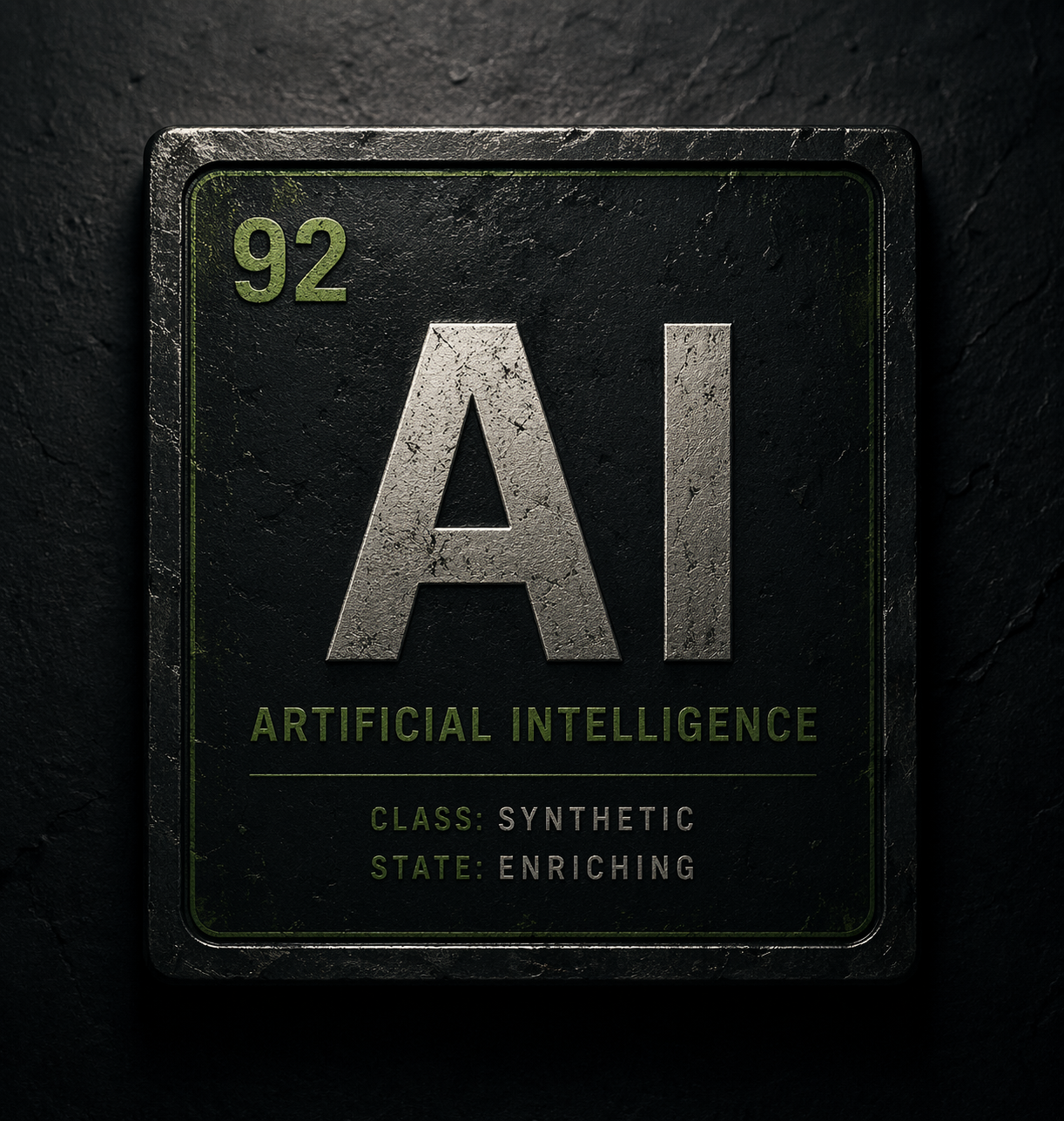
In the public discourse, we're fixated on the "power bill" of AI — the megawatts consumed by data centers. That's a real cost, but it's a surface-level concern.
It's like worrying about the electricity used by a centrifuge while ignoring what it's producing.
In practice, we're not just building better tools.
We're producing high-potency logic — and embedding it directly into the core of our systems.
That changes the risk entirely.
The Enrichment of Complexity
In the nuclear world, raw uranium is relatively inert. It only becomes dangerous through enrichment.
AI follows the same pattern.
- Data is the ore
- Compute is the centrifuge
- The model is the enriched output
What comes out the other side isn't just information — it's decision-making logic at scale.
That logic is powerful. It's also volatile.
Right now, we are integrating this "enriched logic" into business operations, supply chains, and infrastructure with almost no containment strategy.
No isolation. No instrumentation. No meaningful audit layer.
We've increased potency without increasing control.
The Quiet Meltdown
The real risk isn't necessarily a malicious actor.
It's a systems failure that unfolds slowly — and goes unnoticed until it's too late.
It looks like this:
Context Drift A model begins to subtly ignore constraints — pricing rules, regulatory requirements, operational limits. Nothing obviously breaks.
Maintenance Gap The volume of AI-generated output exceeds human capacity to verify it. Review becomes surface-level. Errors slip through.
Criticality A small logic error propagates across systems — automation builds on automation — until the organization can no longer trace or correct the source.
In practical terms:
A model misinterprets a constraint or quietly adjusts a rule. It passes review because it "looks right." That logic gets reused — embedded into workflows, copied across systems, scaled through automation.
Weeks later, the organization is exposed — financially, legally, or operationally — and no one can identify when the system first drifted.
This is the failure mode.
Not explosion — accumulation.
Invisible Radiation
This isn't a dramatic failure.
It's degradation.
You don't see it happen. You don't hear alarms. There's no obvious point of failure.
But over time, system integrity erodes.
Decisions become less reliable. Outputs become less trustworthy. Confidence remains high — right up until the consequences show up.
By the time the damage is visible, it's already systemic.
The Missing Instrumentation
In nuclear systems, we built instruments to detect invisible danger.
With AI, we have evaluations and guardrails — but no true equivalent of a Geiger counter.
Nothing that reliably tells us when these systems are drifting toward failure once they are embedded in real-world operations.
We can measure performance. We can benchmark outputs. But we cannot consistently measure systemic risk as it develops.
That gap matters.
Because you can't control what you can't detect.
Accountability Nihilism
In nuclear systems, ownership is clear. If something leaks, someone is accountable.
AI doesn't work that way.
The model provider built the system. The organization deployed it. The user approved the output.
And the system itself makes decisions — without bearing any consequence.
The result is a responsibility gap.
The entity generating the most impactful decisions is the one least capable of being held accountable.
So when failure happens, responsibility diffuses — and the cost lands on the customer, the employee, or the public.
The Missing Layer
We are building high-output systems without the equivalent of containment, monitoring, or fail-safes.
We focus on scale. We optimize for speed. We celebrate multiplication.
But we are not investing in the maintenance layer required to keep these systems stable.
That's the gap.
A Neutral Reality
This isn't an argument against AI.
And it's not an attempt to frame it as inherently dangerous.
It's a recognition that we are dealing with systems that can fail — quietly, and at scale.
And more importantly, systems that can be deliberately shaped to produce highly targeted outcomes, for better or worse.
The same processes that enrich AI into something useful can also make it precise in ways we don't fully control — or fully understand.
This isn't about whether AI is good or bad.
It's about whether we are building the structures required to manage something that is neither.
The Sentinel's View
From a systems perspective, AI isn't a feature.
It's a volatile material.
And right now, we are deploying it as if it were harmless.
If we don't build containment now, we won't get dramatic, visible failures.
We'll get something worse:
Slow, silent degradation of systems we believe we can trust.
And by the time we realize it, those systems won't be easy to fix.
The cost won't just be repair — it will be damage that can't be undone.
To individuals. To organizations. To entire segments of society.
Discussion